How to Preserve the Mental Health of HR Directors?
The mental health of HR directors has been deteriorating in recent years. Diagnosis, risks, and solutions—Intuition Software explains everything.

HR Directors' Mental Health: A Growing Challenge in 2025
In 2025, the HR function, and specifically HR directors, suffers from professional burnout at multiple levels: work overload, increased responsibilities, psychological pressure, etc. However, the mental health of human resources professionals** is a crucial issue for a company's proper functioning, as this function is essential for team performance.
Intuition Software explains everything about the causes of HR directors' mental exhaustion and the ways to preserve their mental health in the face of emotional, social, and organizational demands of their profession.
- HR directors' mental health in summary
- What is HR professional burnout?
- What are the common causes of HR directors' professional burnout?
- Evaluation of the HR function's mental health
- What are the impacts of HR directors' mental health on a company?
- How to prevent HR directors' professional burnout?
- What are the indicators to monitor and measure HR mental health?
HR Directors' Mental Health in Summary
- HR directors' mental health refers to their ability to maintain psychological balance in the face of emotional, social, and organizational demands of their profession.
- In 2025, the HR function faces an increased risk of workplace burnout: work overload, multiple pressures, lack of resources and high responsibilities, which undermines their well-being.
- This weakening has direct repercussions on the company, as HR is the main link between employees and management. This exhaustion can then lead to poor decisions, social tensions, and a negative work climate.
- To address this, companies must act on three essential levers: prevention, support, and recognition.
What is HR Professional Burnout?
Human resources professionals, such as HR directors, are under significant pressure because they must on one hand defend management strategy while preserving the company's social balance. This dual role is a constant pressure, sometimes compounded by emotional fatigue or management of complex human situations (layoffs, internal conflicts, etc.).
This creates uncontrolled stress situations that have serious consequences on their mental health. HR directors, and the HR function as a whole, can then experience a state of wear conducive to exhaustion, called burnout. This professional burnout is defined by the World Health Organization (WHO) as "a syndrome resulting from chronic workplace stress that has not been successfully managed."
According to the Teale 2024 Barometer, the average mental well-being score of HR professionals reached 50/100 on the WHO index, a level considered critical, marking entry into a state of clinical depression.

What Are the Common Causes of HR Directors' Professional Burnout?
HR directors' professional burnout is explained by the multiplication of daily pressures such as:
- Work overload
- Lack of resources
- Digitalization of HR processes
- Management of complex human situations
The accumulation of these various psychological pressures increases emotional exhaustion, a syndrome that now affects a large part of the HR function. According to the Teale 2025 Barometer, 38% of HR directors are considering leaving their position to preserve their mental health.
Increasing Work Overload
Human resources departments face a multiplication of missions:
- Improvement of employer brand
- Regulatory compliance
- CSR
- Inclusion
- Digitalization of HR processes
- Crisis management (conflicts, brown-out, quiet quitting)
While the scope of HR directors' competence expands more and more, resources do not evolve accordingly. This results in heavier workload on these already high-responsibility positions. As a result, HR directors are often forced to manage a significant mental load** with longer days, more fatigue, and less perspective.
Lack of Resources
The lack of human and budgetary resources is one of the main causes of **HR directors' professional burnout. In many organizations, the same person must handle recruitment, payroll, training, compliance, and social dialogue.
According to the Teale 2024 Barometer, this overload linked to insufficient means is one of the factors most cited by professionals as causes of professional burnout.
Digitalization of HR Processes
HR digitalization aims to automate certain time-consuming administrative tasks. There is therefore a positive objective, but it can sometimes take the form of work overload for HR directors, who find themselves having to manage numerous tools, such as payroll software, ATS, HRIS, etc.
Moreover, using these tools leads to HR directors' hyperconnection, which can affect their work-life balance.
Human Management
HR directors daily face human situations with high emotional load: layoffs, internal conflicts, restructuring, support for distressed employees, or management of teams under tension, etc. These crises can generate a form of emotional wear**, recognized as a burnout factor.
Some factors can be aggravating and increase this emotional load, such as lack of managerial support or lack of prevention measures for mental health (such as implementing stress management training).

Evaluation of the HR Function's Mental Health
Do you think you suffer from mental exhaustion? Take our test, based on WHO-5, the mental well-being index used by the WHO.
Here are the questions to ask yourself to evaluate your mental health:
- I feel fulfilled and satisfied with my professional life
- I feel I am developing and progressing in my work
- I am able to adapt to changes and difficult situations
- I overcome professional obstacles with confidence
- I effectively manage my stress and emotions at work
- I control my reactions to tense situations
- I am confident in my skills and professional value
- I know how to identify my strengths and highlight them
- I maintain positive relationships with my colleagues
- I communicate effectively and resolve conflicts constructively
What Are the Impacts of HR Directors' Mental Health on a Company?
An HR director, in their primary function, must reconcile employee expectations with those of management. They pilot recruitment, support internal transformations, maintain social dialogue, and ensure overall cohesion.
When an HR director has good mental health, the company benefits from a clear vision and stable governance. HR decisions are thus thoughtful, coherent, and aligned with long-term needs, and recruitment and internal communication are smooth.
Conversely, when an HR director is in a state of exhaustion or weakened, they lose this balance and this situation can translate into:
- Social tensions
- Loss of meaning at work
- Degradation of the work climate
It is therefore essential to preserve HR directors' mental health, to protect recruitment stability, managerial coherence, and internal social dialogue.
How to Prevent HR Directors' Professional Burnout?
To prevent HR directors' professional burnout, companies must act on three priority levers:
- Prevention
- Support
- Recognition
Prevention
Prevention allows anticipating the risk of HR directors' burnout instead of reacting when it occurs. This consists of identifying overload signals before they become critical. To be vigilant about HR directors' well-being, several actions can be implemented:
- Introduce internal barometers of psychological health, anonymous and regular.
- Train managers to identify early signs of burnout: irritability, disengagement, sleep disorders, or decreased concentration.
- Integrate a mental health prevention plan into HR policy, including training, awareness, and support. According to the Qualisocial / Ipsos 2024 Barometer, only 23% of companies** have such a plan, when it is now a strategic priority.
Support and Accompaniment
HR directors also need a space where they can confide, deposit their emotional load, and share their difficulties. For this, it is possible to:
- Create secure exchange spaces (discussion groups, collective coaching, etc.)
- Promote mentoring between HR directors to break decision-making isolation
- Guarantee confidential access to external psychological support, such as an occupational psychologist
Recognition and Work Valorization
Lack of recognition means that the vision of HR directors' role is sometimes reduced to an operational or administrative function, when they directly contribute to the company's overall performance.
This lack of valorization often creates frustration and a loss of meaning at work, especially in a profession where emotional load is already high. To avoid this, several actions are possible:
- Define clear areas of responsibility: the HR director must know where their field of action extends and from what point other actors take over (management, managers, service providers).
- Encourage delegation and autonomy: HR directors must be able to rely on other people, such as payroll managers, recruitment officers, or training managers. They must not only have the space to do so, but also the intention to delegate. Collaborative tools, such as recruitment software**, can facilitate this equitable distribution of work.

What Are the Indicators to Monitor and Measure HR Mental Health?
To evaluate HR teams' mental health, several concrete indicators can identify professional burnout signals:
- HR absenteeism rate: a high absenteeism level can reveal chronic stress, work overload, or progressive disengagement.
- Turnover rate in the HR function: significant rotation indicates organizational malaise and lack of recognition of the function.
- Average job satisfaction score: measures overall HR feelings and allows tracking the evolution of their motivation and balance.
- Number of unused vacation days: unused vacation often signals difficulty disconnecting and overinvestment.
- Average weekly working hours of HR directors: work weeks that are too long indicate overload and risk of burnout.
- Internal WHO-5 score: based on the WHO model, it offers a reliable and regular measure of HR psychological well-being level.
HR directors' mental health is now an issue that conditions management quality, social dialogue stability, and overall team performance. By acting on prevention, support, and recognition, organizations can strengthen their HR teams' resilience and thus preserve collective balance.
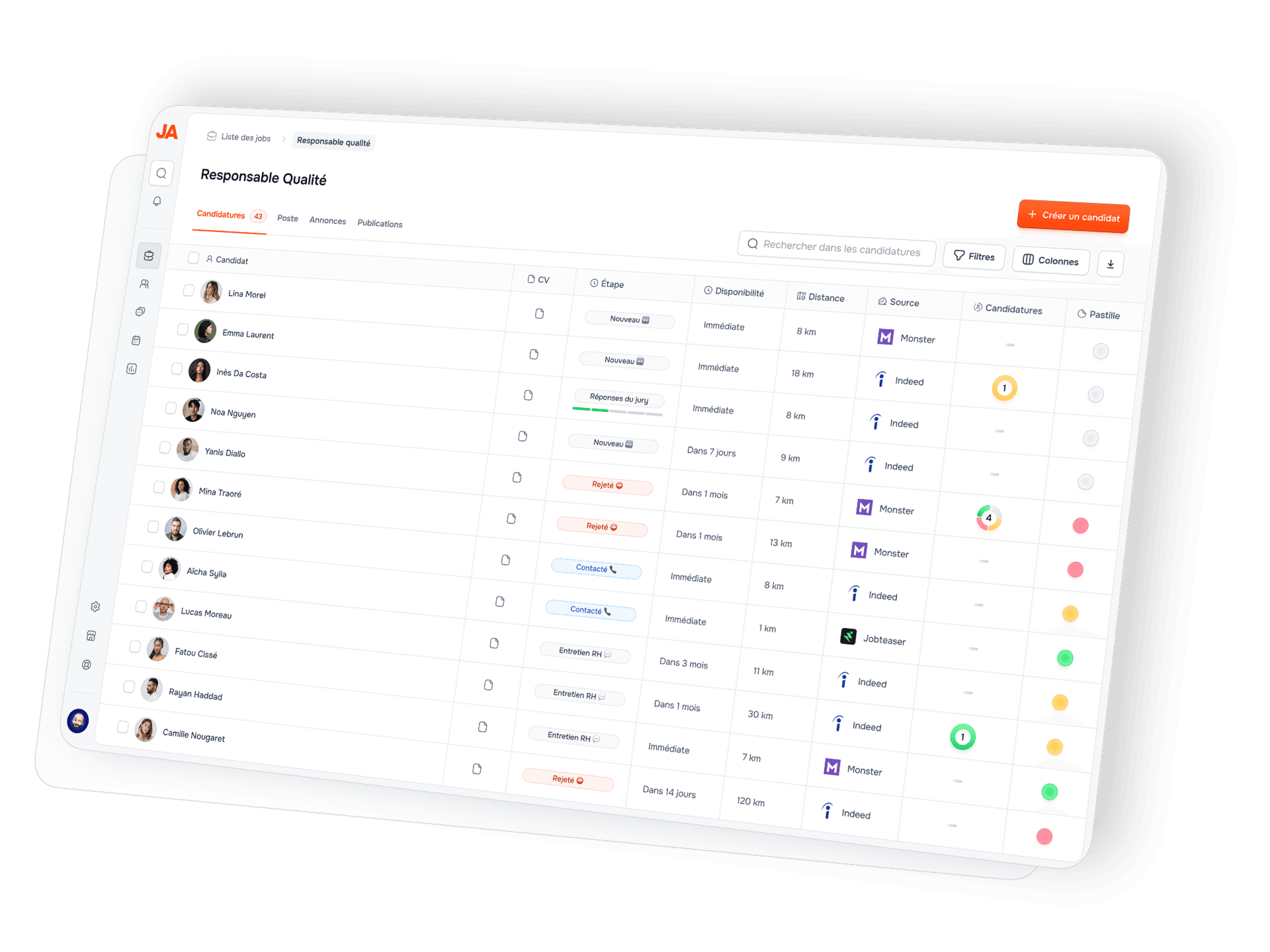
Do you want to better support your HR teams and improve quality of work life? Intuition Software helps you structure your recruitment and talent management processes with JobAffinity, an ATS software designed to simplify HR directors' and recruiters' daily work and help foster a healthier, more human, and more efficient company culture.